
Introducing the LocalScale FundingHub

- 2026-03-17 06:58:24.0
- 19716
- regenerative finance, trust, proof graph, FundingHub
Environmental and regenerative finance is undergoing rapid growth, yet remains structurally constrained by fragmentation, limited trust in reported outcomes, and the absence of mechanisms to coordinate multiple funders and implementers at scale. Existing systems prioritize capital deployment over verified impact and often fail to incentivize collaboration across actors. This post introduces the LocalScale FundingHub, a modular infrastructure designed to enable trust-driven, outcome-based, and collaborative financing ecosystems.
Listen to the podcast version below:
The system integrates three foundational components:
- the Proof Graph, a verifiable data layer for environmental activity
- the Trust Engine, a dynamic mechanism for evaluating credibility and performance
- the FundingHub, a capital allocation system aligned with verified outcomes
Together, these components form a unified architecture that ensures data integrity, transparency, and adaptive capital flows, enabling funders and implementers to coordinate effectively in complex, multi-stakeholder environments.
1. Introduction: The Structural Problem in Environmental Finance
Environmental finance today exists within a paradoxical state of expansion and limitation. While capital commitments toward sustainability, biodiversity, and climate resilience are increasing across corporate, public, and philanthropic domains, the mechanisms through which this capital is deployed remain constrained by structural inefficiencies. These inefficiencies do not stem from a lack of intent or resources, but from the absence of a unified infrastructure capable of coordinating actors, verifying outcomes, and aligning incentives at scale.
1.1 Fragmentation of Funding and Data
One of the most significant barriers to effective environmental finance is the fragmentation of both funding flows and the data systems that support them. Capital is distributed across a wide array of institutions, each operating with its own mandates, reporting frameworks, and verification standards. Corporate sustainability programs, government grants, and philanthropic initiatives often coexist within the same geographic regions, yet operate in isolation from one another.
This fragmentation extends to the data generated by projects. Environmental data is frequently collected using disparate methodologies, stored in incompatible formats, and reported through siloed systems. As a result, even when multiple actors are contributing to similar outcomes within a shared landscape, their efforts cannot be easily aggregated, compared, or validated collectively. The absence of a shared data layer prevents the formation of a coherent picture of impact and undermines the ability to coordinate interventions at the ecosystem level.
1.2 Weak Verification Mechanisms
Verification remains one of the weakest links in the current system. Most environmental projects rely on periodic reporting cycles, often supplemented by external audits or certifications. While these mechanisms provide a degree of assurance, they are inherently limited in both scope and frequency. They capture snapshots of performance rather than continuous signals, and they often depend on self-reported data that may be incomplete or biased.
Furthermore, traditional verification approaches do not adequately account for the quality or reliability of the underlying data. A reported outcome is typically treated as a binary condition—either verified or not—without a nuanced assessment of the confidence that can be placed in that verification. This lack of granularity makes it difficult for funders to assess risk accurately and for implementers to differentiate themselves based on the rigor of their data practices.
1.3 Misaligned Incentives
The combination of fragmented systems and weak verification mechanisms leads to a set of misaligned incentives that hinder effective collaboration. Organizations are often incentivized to compete for funding rather than collaborate toward shared outcomes. Success is frequently measured in terms of activities completed or funds deployed, rather than the quality and durability of environmental impact.
In this context, reporting becomes an exercise in compliance rather than a mechanism for learning and improvement. Data sharing is discouraged due to concerns over attribution and competitive positioning, and collaboration introduces additional complexity without corresponding financial reward. As a result, the system tends to favor isolated, short-term projects over coordinated, long-term interventions.
The cumulative effect of these dynamics is a landscape in which capital is available but cannot be deployed efficiently at scale. Trust, which is essential for coordinating multiple actors and funding sources, remains limited and difficult to establish. Addressing this challenge requires not only new financial instruments, but a fundamental rethinking of the infrastructure through which data, trust, and capital are connected.
2. Design Principles
The LocalScale FundingHub is designed in response to the structural challenges outlined above. Its architecture is grounded in a set of principles that reflect the need for both technical robustness and institutional adaptability. These principles guide the design of the system and ensure that it can function effectively across diverse contexts and stakeholder groups.
2.1 Verifiability
At the core of the system is the principle of verifiability. In an environment where financial decisions are increasingly tied to claims of environmental impact, it is essential that every claim can be traced, examined, and validated. Verifiability requires that data be structured in a way that preserves its origin, context, and lineage. Each piece of evidence must be linked to the specific action it supports, the location in which it was generated, and the actors responsible for its creation and validation.
This principle extends beyond the mere availability of data. It implies the existence of a transparent and auditable process through which data is generated, recorded, and evaluated. By ensuring that all claims are grounded in verifiable evidence, the system creates a foundation upon which trust can be built and scaled.
2.2 Dynamic Trust
Traditional approaches to trust in environmental finance rely heavily on static indicators such as organizational reputation or certification status. While these indicators provide some value, they do not capture the dynamic nature of performance in complex systems. The LocalScale approach treats trust as an evolving property that is continuously updated based on new information.
Dynamic trust is computed by aggregating multiple signals, including the quality and completeness of evidence, the strength of attestations, and the historical performance of actors. As new data enters the system, trust scores are recalibrated to reflect the most current state of knowledge. This allows the system to respond to changes in performance in real time, rewarding consistent delivery and identifying areas of uncertainty or risk.
2.3 Outcome Orientation
A fundamental shift introduced by the LocalScale architecture is the move from activity-based to outcome-based evaluation. While activities and outputs are necessary components of any project, they do not in themselves guarantee meaningful environmental impact. Outcome orientation places emphasis on measurable changes in ecological conditions, such as improvements in water retention, soil health, or biodiversity.
By linking funding decisions to verified outcomes, the system creates a direct connection between impact and financial reward. This does not eliminate the need for upfront investment, but it introduces a mechanism through which future funding can be informed by demonstrated results. Over time, this alignment encourages actors to focus on interventions that produce durable, high-quality outcomes.
2.4 Interoperability
Environmental finance encompasses a wide range of funding sources, regulatory frameworks, and implementation models. A system that seeks to operate at scale must be capable of integrating with this diversity rather than imposing a rigid structure. Interoperability is therefore a central design requirement.
The LocalScale architecture is designed to accommodate multiple types of capital, including corporate sustainability funds, public sector grants, and market-based instruments such as green bonds. It provides a common layer for data verification and trust computation, while allowing each funding source to maintain its own constraints and governance structures. This flexibility enables the system to act as a unifying infrastructure without disrupting existing financial ecosystems.
2.5 Collaboration Incentivization
Environmental challenges at the scale of ecosystems cannot be addressed by individual actors working in isolation. Effective intervention requires coordination across organizations, sectors, and geographies. However, existing funding systems often fail to support collaboration, both financially and structurally.
The LocalScale FundingHub is designed to make collaboration economically viable. By providing a shared infrastructure for tracking contributions and verifying outcomes, it allows multiple actors to participate in the same project while maintaining clarity over roles and responsibilities. Trust scores reflect not only individual performance but also collaborative behavior, creating incentives for actors to work together toward shared goals. In this way, collaboration becomes a measurable and rewarded component of the system.
3. System Architecture Overview
The LocalScale system consists of three tightly integrated layers:
- Proof Graph: Data layer capturing all events and evidence
- Trust Engine : Analytical layer computing credibility and confidence
- FundingHub : Financial layer allocating and routing capital
Each layer reinforces the others, creating a feedback loop between data, trust, and capital.
3.1 The Proof Graph as the Data Layer
At the foundation of the system lies the Proof Graph, which serves as the primary repository for all events and data. The Proof Graph captures environmental outcomes, supporting evidence, attestations, and financial agreements as interconnected elements within a graph structure. This approach preserves the relationships between different pieces of information, allowing each outcome to be understood in the context of its supporting data and verification processes.
Every event recorded in the Proof Graph is associated with a specific time, location, and set of actors. Additionally, events can be cryptographically signed, ensuring that their origin and integrity can be independently verified. This creates a tamper-resistant record that supports transparency and auditability across the system.
3.2 The Trust Engine as the Analytical Layer
Building on the data captured in the Proof Graph, the Trust Engine performs the critical function of evaluating credibility and performance. It processes signals related to evidence quality, attestation strength, and historical behavior to compute trust scores for actors, projects, and outcomes.
The Trust Engine operates dynamically, updating its assessments as new data becomes available. This allows it to capture the evolving nature of environmental systems and the performance of participants within them. By providing a nuanced, continuously updated view of trust, the engine enables more informed decision-making at all levels of the system.
3.3 The FundingHub as the Financial Layer
The FundingHub translates trust signals into actionable financial decisions. It manages capital from multiple sources, organizing it into structured pools with defined rules and constraints. When a project seeks funding, the FundingHub evaluates its eligibility and risk profile using the outputs of the Trust Engine.
This enables a more adaptive approach to capital allocation. Funding levels, conditions, and disbursement schedules can be adjusted based on the credibility of the project and its participants. Projects with strong, verifiable track records can access capital more readily, while those with lower levels of trust may be subject to additional conditions or phased funding.
3.4 Integrated Feedback Loop
The defining feature of the LocalScale architecture is the integration of its three layers into a continuous feedback loop. Data generated through project activities is recorded in the Proof Graph, where it becomes the basis for trust computation. The Trust Engine evaluates this data and produces signals that inform the FundingHub. In turn, the FundingHub’s allocation decisions influence the behavior of actors, shaping future data generation.
This cyclical process ensures that the system is self-reinforcing. High-quality data leads to higher trust, which enables greater access to capital, which in turn incentivizes the continued production of reliable data. Conversely, weak or unreliable data results in lower trust and more constrained funding, encouraging improvements in data practices.
Through this integrated architecture, the LocalScale FundingHub establishes a coherent infrastructure in which data, trust, and capital are aligned, enabling more effective and scalable environmental finance.
4. The Proof Graph: A Verifiable Data Layer
The Proof Graph is a structured, event-based system that records all activities, evidence, and validations within a project ecosystem.

4.1 Event-Based Model
All system interactions are recorded as events, including: environmental outcomes evidence submissions attestations agreements and funding commitments Each event is: timestamped linked to a specific project or geography cryptographically signed This creates a tamper-resistant record of activity.
4.2 Traceability and Auditability
Every outcome can be decomposed into its underlying components:
- raw evidence
- verification steps
- contributing actors
This enables:
- full audit trails
- independent verification
- cross-organizational transparency
5. Evidence Evaluation Framework
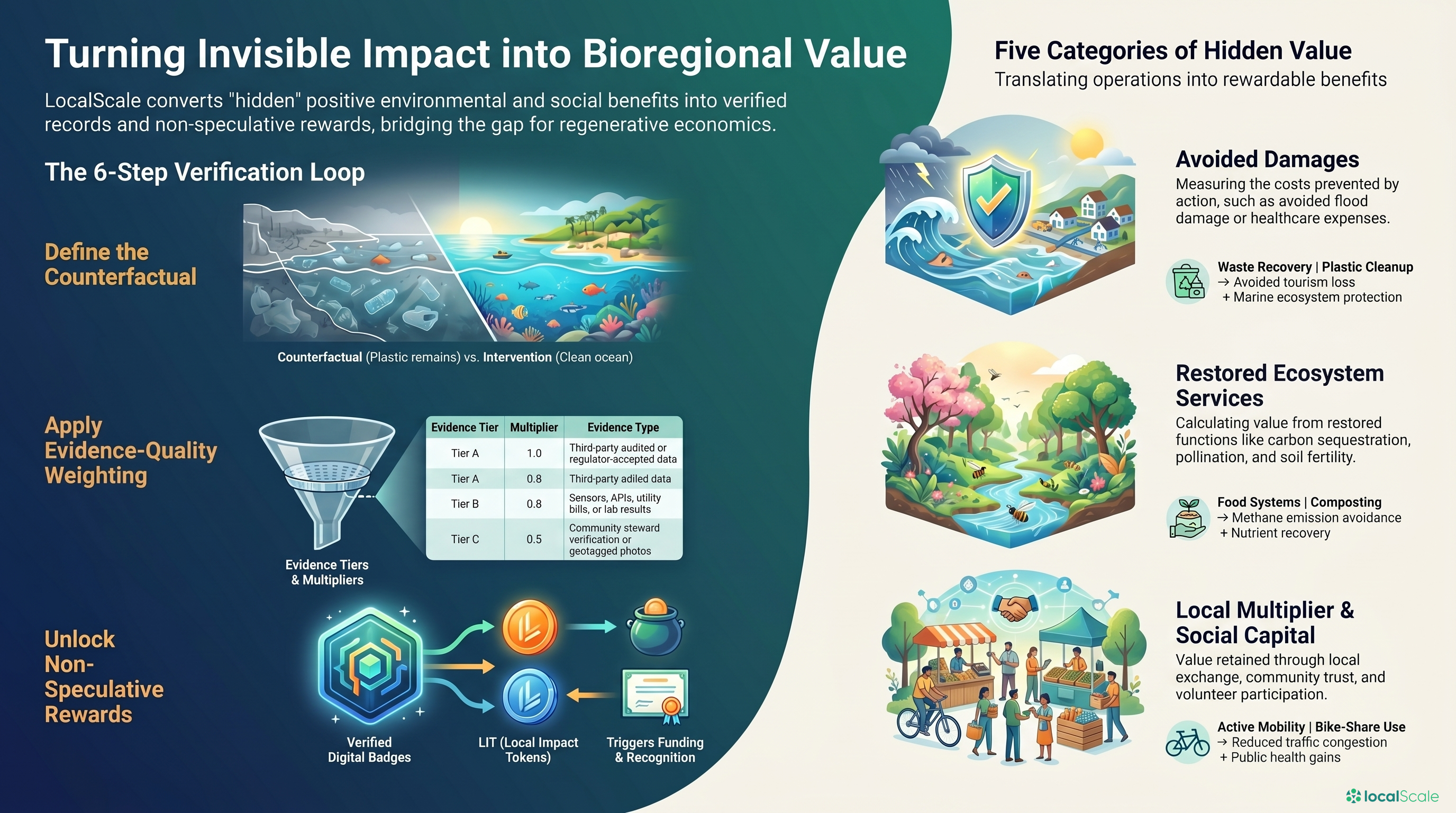
A central requirement for any outcome-based financial system is the ability to distinguish between high-quality and low-quality data. In environmental contexts, where measurements are often complex, distributed, and subject to uncertainty, this challenge becomes particularly acute. The LocalScale FundingHub addresses this by implementing a structured framework for evaluating evidence, ensuring that all data contributing to outcome verification is assessed in a consistent, transparent, and auditable manner.
5.1 Evidence Quality Dimensions
Within the system, evidence is not treated as an auxiliary input, but as a first-class component of the data model. Each piece of evidence is explicitly recorded in the Proof Graph and linked to the outcome it supports, the actors responsible for its generation, and the context in which it was produced. This ensures that evidence is always interpretable within a broader chain of causality and accountability.
By structuring evidence in this way, the system enables not only verification of individual claims, but also the aggregation and comparison of data across projects, geographies, and time periods. This creates the foundation for a shared understanding of environmental performance.
5.2 Dimensions of Evidence Quality
The quality of evidence is evaluated along multiple dimensions, each capturing a different aspect of reliability. Source reliability reflects the degree to which the origin of the data can be trusted, distinguishing between automated systems, independent audits, and self-reported information. Measurement method quality assesses the rigor and repeatability of the process used to generate the data, recognizing that different methodologies carry different levels of precision and uncertainty.
Data integrity addresses the question of whether the evidence has been preserved in a secure and tamper-resistant manner. This includes the use of cryptographic signatures, the availability of raw data, and the robustness of the data pipeline. Completeness evaluates whether all required information is present, ensuring that the evidence can be properly interpreted and contextualized.
These dimensions are combined into a composite quality score, which provides a quantitative representation of the strength of the evidence. This score is not static; it can evolve as additional information becomes available, such as new attestations or supplementary data.
5.3 Completeness and Structural Validity
Completeness plays a critical role in determining whether evidence is usable within the system. Even high-quality data sources can produce incomplete records that lack essential contextual information. By explicitly evaluating completeness, the system ensures that only evidence meeting minimum structural requirements contributes fully to outcome verification.
This approach also creates incentives for data producers to adhere to standardized reporting practices. Evidence that is incomplete or poorly structured is automatically discounted, encouraging actors to provide comprehensive and well-documented data.
5.4 Aggregation and Weighting
Environmental outcomes are rarely supported by a single piece of evidence. Instead, they are typically derived from multiple data points, each with varying levels of quality and reliability. The system aggregates these inputs using a weighting mechanism that reflects their respective quality scores.
Higher-quality evidence exerts a greater influence on the final outcome assessment, while lower-quality evidence contributes proportionally less. This approach allows the system to incorporate a wide range of data sources without treating them as equivalent, resulting in a more nuanced and robust evaluation of outcomes.
6. Attestation and Verification
While evidence provides the raw data underlying environmental claims, verification is necessary to establish confidence in that data. The LocalScale system introduces a structured approach to attestation, enabling multiple actors to validate evidence and contribute to a shared understanding of its reliability.
6.1 Role of Attestations
Attestations represent explicit statements by actors regarding the validity of a piece of evidence or an outcome. These actors may include governmental bodies, independent auditors, non-governmental organizations, or peer entities within the system. Each attestation is recorded as an event within the Proof Graph, linked to the evidence or outcome it supports.
This structure allows for multiple, independent attestations to be associated with the same piece of evidence, creating a layered verification process. Rather than relying on a single authority, the system supports a plurality of validators, each contributing to the overall assessment.
6.2 Attestation Strength and Context
Not all attestations carry equal weight. The strength of an attestation depends on the nature of the verification process and the level of accountability associated with it. Formal audits and legally binding certifications typically provide stronger signals than informal reviews or self-attestations.
In addition to the type of attestation, the system considers the context in which it is made. Factors such as the degree of scrutiny applied, the methodologies used, and the potential consequences of incorrect validation all influence the strength of the attestation. This ensures that the system captures not only the presence of verification, but also its rigor.
6.3 Separation of Attestation Weight and Attestor Trust
A key design feature of the system is the separation between the inherent strength of an attestation and the historical credibility of the actor providing it. Attestation weight reflects the characteristics of the verification process itself, while attestor trust is derived from the Trust Engine based on the actor’s past performance.
These two components are combined to produce an effective contribution to outcome confidence. This separation prevents the system from over-relying on reputation alone, ensuring that even highly trusted actors must provide strong, methodologically sound attestations, while less established actors can still contribute meaningfully if they adhere to rigorous processes.
6.4 Multi-Party Verification
By allowing multiple attestations to coexist, the system supports a form of distributed verification. Conflicting attestations can be recorded and analyzed, with their respective weights and trust scores determining their influence on the final outcome assessment. This approach acknowledges the inherent uncertainty in environmental data and provides a mechanism for resolving discrepancies through transparent, data-driven processes.
7. The Trust Engine: Dynamic Credibility Computation
The Trust Engine serves as the analytical core of the LocalScale system, transforming raw data and verification signals into actionable measures of credibility. It operates continuously, updating its assessments as new information becomes available and providing a dynamic representation of trust across the ecosystem.
7.1 Inputs to Trust Computation
Trust is derived from a combination of factors, including the quality and completeness of evidence, the strength and reliability of attestations, and the historical behavior of actors. These inputs are not treated in isolation; rather, they are integrated into a composite model that reflects the interplay between data quality, verification rigor, and performance over time.
By incorporating multiple dimensions, the Trust Engine avoids simplistic assessments and captures the complexity inherent in environmental systems. This enables a more accurate representation of both risk and reliability.
7.2 Outcome Confidence
At the level of individual outcomes, the Trust Engine computes a confidence score representing the likelihood that a reported outcome is accurate and verifiable. This score is derived from the aggregation of evidence and attestation signals, adjusted for factors such as recency and consistency.
Outcome confidence provides a continuous measure rather than a binary classification, allowing for more nuanced decision-making. Funders and other stakeholders can use this information to assess the degree of certainty associated with different outcomes and to allocate resources accordingly.
7.3 Temporal Dynamics and Recency
Environmental data is inherently time-sensitive. Measurements that were valid at one point may become less relevant as conditions change. The Trust Engine accounts for this by incorporating temporal dynamics into its calculations, assigning greater weight to recent data while gradually discounting older information.
This ensures that trust scores remain aligned with current conditions and encourages the continuous generation of up-to-date evidence.
7.4 Incremental and Scalable Computation
To operate effectively at scale, the Trust Engine is designed to update its calculations incrementally. Rather than recalculating trust scores from scratch each time new data is added, the system adjusts existing scores based on the marginal impact of new events. This approach enables real-time responsiveness while maintaining computational efficiency, making it suitable for large, distributed datasets.
8. Cryptographic Integrity and Security
Trust in environmental finance depends not only on the quality of data and verification processes, but also on the integrity of the system in which they are recorded. The LocalScale FundingHub incorporates cryptographic mechanisms to ensure that all data is secure, traceable, and resistant to tampering.
8.1 Cryptographic Signatures
Each event recorded in the Proof Graph can be cryptographically signed by the actor responsible for its creation. These signatures provide a verifiable link between the data and its origin, ensuring that any modification to the event can be detected. This establishes a foundation of non-repudiation, where actors cannot deny their contributions to the system.
8.2 Data Integrity and Tamper Resistance
By combining cryptographic signatures with structured data storage, the system ensures that all records maintain their integrity over time. Any attempt to alter or remove data would be detectable, preserving the reliability of the audit trail. This is particularly important in multi-stakeholder environments, where trust cannot be assumed and must instead be enforced through technical means.
8.3 Transparency and Traceability
The system is designed to provide full transparency into the lifecycle of each outcome. Stakeholders can trace a given outcome back through its supporting evidence, attestations, and associated actors. This level of traceability enables independent verification and fosters confidence among participants, as all claims are supported by a clear and accessible chain of evidence.
8.4 Decentralized Trust Model
By distributing data and verification across multiple actors, the system reduces reliance on any single authority. Trust is not centralized but emerges from the collective validation of participants, supported by cryptographic guarantees. This decentralized model enhances resilience and ensures that the system can operate effectively across different institutional and geographic contexts.
9. The FundingHub: Intelligent Capital Allocation
The FundingHub represents the financial coordination layer of the LocalScale system. While the Proof Graph captures verifiable data and the Trust Engine computes credibility, the FundingHub operationalizes these signals by directing capital flows in a manner that reflects real-world performance and risk.
At its core, the FundingHub is designed to support a many-to-many financing structure, in which multiple funders contribute capital to multiple projects, and multiple implementing actors collaborate within shared landscapes. This departs from traditional one-to-one funding relationships and enables a more flexible and scalable model of environmental finance.
9.1 Structure of Funding Pools
Capital within the FundingHub is organized into discrete Funding Pools. Each pool represents a source of capital with its own objectives, constraints, and governance parameters. These may include corporate sustainability funds, proceeds from green bonds, philanthropic capital, or public sector grants.
Each Funding Pool defines the conditions under which its capital can be deployed. These conditions may include geographic scope, eligible activities, target outcomes, and risk tolerance. By structuring capital in this way, the system allows diverse funding sources to coexist within a shared infrastructure while preserving their individual mandates.
Funding Pools are not static entities. They can be replenished, combined, or allocated across multiple projects, allowing capital to flow dynamically in response to evolving conditions and opportunities.
9.2 Trust-Aware Allocation Mechanisms
The allocation of capital from Funding Pools is guided by the outputs of the Trust Engine. When a project or proposal seeks funding, the system evaluates its eligibility and risk profile based on a combination of factors, including the trust scores of participating actors, the historical performance of similar projects, and the quality of available evidence.
This enables a shift from static, proposal-based allocation toward a more adaptive model in which funding decisions reflect the current state of knowledge. Projects with strong, verifiable track records may receive accelerated or less constrained funding, while those with higher uncertainty may be subject to staged disbursement or additional verification requirements.
Importantly, this approach does not exclude lower-trust actors. Instead, it provides a pathway for participation in which funding is aligned with demonstrated performance and the gradual accumulation of trust.
9.3 Capital as a Feedback Mechanism
Within the FundingHub, capital is not only a resource to be allocated, but also a mechanism for shaping behavior. By linking funding conditions to trust signals, the system creates incentives for actors to produce high-quality data, engage in rigorous verification processes, and collaborate effectively.
Over time, this feedback loop encourages the emergence of best practices and reinforces behaviors that contribute to reliable, high-confidence outcomes. In this sense, the FundingHub functions as both a financial system and a governance mechanism.
10. Enabling Collaborative Finance: Outcome-Based Financing and Pay-for-Success
A defining feature of the LocalScale FundingHub is its ability to support outcome-based financing models, in which capital is disbursed based on the achievement of predefined, measurable results. This approach aligns financial incentives with environmental impact and enables more efficient allocation of resources.
10.1 Outcome Contracts
Outcome-based financing is implemented through Outcome Contracts, which specify the conditions under which payments will be made. Each contract defines a set of measurable indicators, such as improvements in water quality, increases in soil carbon, or restoration of biodiversity, along with the thresholds that must be met for payment to be triggered.
These contracts are linked to specific projects and recorded within the Proof Graph, ensuring that their terms are transparent and auditable. By formalizing the relationship between outcomes and payments, the system creates a clear framework for accountability.
10.2 Automated Evaluation of Outcomes
The evaluation of outcomes is performed automatically by the system, using data from the Proof Graph and the analytical capabilities of the Trust Engine. Evidence related to a given outcome is collected and assessed for quality, completeness, and integrity. Attestations are incorporated to validate the data, and a confidence score is computed to reflect the reliability of the outcome.
Once the relevant metrics are evaluated, the system determines whether the thresholds defined in the Outcome Contract have been met. This process is continuous, allowing outcomes to be reassessed as new data becomes available.
10.3 Triggering of Payments
When an outcome meets the required thresholds with sufficient confidence, the FundingHub triggers the corresponding payment from the relevant Funding Pools. This process can be fully or partially automated, reducing administrative overhead and ensuring that payments are made in a timely and transparent manner.
By linking payments directly to verified outcomes, the system ensures that capital is deployed where it generates measurable impact. This reduces the risk for funders and provides clear incentives for implementers to focus on results.
10.4 Managing Uncertainty and Partial Outcomes
Environmental outcomes are often subject to uncertainty and variability. The system accounts for this by allowing for partial fulfillment of contracts, where payments can be scaled based on the degree to which thresholds are met. Confidence scores further refine this process by incorporating the reliability of the underlying data.
This flexible approach enables outcome-based financing to be applied in complex, real-world contexts without requiring absolute certainty, while still maintaining a strong link between performance and payment.
11. Enabling Multi-Funder and Collaborative Finance
One of the primary objectives of the LocalScale FundingHub is to enable effective collaboration between multiple funders and implementing actors. This is particularly relevant in contexts where environmental challenges span large geographies and require coordinated action across sectors.
11.1 Many-to-Many Funding Structures
Traditional funding models are typically characterized by bilateral relationships between a single funder and a single implementing organization. While this structure is simple, it does not scale effectively to complex systems where multiple actors must contribute to shared outcomes.
The FundingHub enables a many-to-many structure, in which multiple funders can allocate capital to multiple projects, and multiple implementers can collaborate within those projects. This allows capital from different sources to be pooled and deployed in a coordinated manner, increasing both efficiency and impact.
11.2 Blended Finance and Capital Stacking
The system is designed to support blended finance models, in which different types of capital are combined to achieve specific objectives. For example, corporate sustainability funds may be used to de-risk projects, enabling the mobilization of public sector grants or private investment.
By providing a common infrastructure for tracking outcomes and verifying impact, the FundingHub allows these different forms of capital to be aligned around shared goals. This facilitates capital stacking, where multiple funding sources contribute to the same set of outcomes, each playing a complementary role.
11.3 Integration of Corporate and Public Funding
The architecture is particularly well-suited to integrating corporate funding, including proceeds from green bonds, with public sector financing mechanisms. Corporate capital can be directed toward outcome-based contracts, while public funds provide baseline support for project implementation.
This creates a leverage effect, in which private capital amplifies the impact of public funding. At the same time, the verification and trust infrastructure ensures that all parties have confidence in the outcomes being achieved.
11.4 Governance and Shared Accountability
Effective collaboration requires not only technical infrastructure but also governance structures that ensure accountability and alignment. The FundingHub supports the creation of shared governance models involving funders, implementers, and other stakeholders.
By providing transparent data and trust metrics, the system enables informed decision-making and reduces the potential for disputes. All participants have access to the same underlying information, creating a common basis for coordination and oversight.
12. Conclusion
The challenges facing environmental finance are not solely a matter of capital availability. Rather, they stem from the absence of a coherent infrastructure capable of coordinating data, trust, and financial flows across a diverse set of actors. Without such infrastructure, efforts remain fragmented, verification remains limited, and collaboration remains difficult to sustain.
The LocalScale FundingHub addresses these challenges by introducing a system in which every claim is supported by verifiable evidence, every verification is evaluated for its strength and reliability, and every funding decision is informed by dynamically computed trust. By integrating the Proof Graph, Trust Engine, and FundingHub into a unified architecture, the system creates a continuous feedback loop that aligns behavior, data, and capital.
This approach represents a shift from traditional models of environmental finance, which rely on static reporting and centralized verification, toward a more adaptive and transparent system. In this new model, trust is not assumed or delegated; it is continuously generated through the interaction of data, verification, and performance.
For organizations such as World Wide Fund for Nature, this infrastructure provides a pathway to scale impact by enabling collaboration across funders, implementers, and geographies. It allows diverse sources of capital to be aligned around shared outcomes, while maintaining the transparency and accountability required to manage risk.
Ultimately, the LocalScale FundingHub lays the foundation for a new class of financial systems in which capital flows are directly tied to verified, high-confidence outcomes. By doing so, it enables the transition from fragmented, trust-constrained processes to coordinated, outcome-driven ecosystems capable of addressing environmental challenges at scale.
Final Perspective
The central challenge in regenerative finance is not capital availability, but trust coordination at scale. LocalScale addresses this challenge directly by ensuring that: every claim is supported by verifiable evidence every verification is itself evaluated every funding decision is tied to measurable outcomes In doing so, it enables a new class of financial systems where: trust is not assumed -- it is continuously computed, proven, and rewarded.